Blog · Getting started · Leer en español · Ler em português
What a newsletter is, what it isn't, and how to start your own
What a newsletter is, how it differs from social media and from an email campaign, and how to start your own with the people who already know you.

A newsletter is an email you write regularly to people who asked to receive it. It has three parts, and all three matter: people who said yes, a cadence you keep and a list that's yours, one you take with you wherever you go. If one is missing, it's something else, whether that's a mass email, a sales campaign or a post on a social network that shows you today and not tomorrow.
That's the short answer. The one I care about is different, because for years I thought the question wasn't even worth asking (there may be another article in that): why write to someone by email if they already follow me on social media? My paradigm was that email was obsolete, that people don't read emails anymore and that everything happened on social media, on WhatsApp, anywhere but email.
What changed my mind were the digital marketing and SEO videos I started watching, and one of the people who kept insisting that email still works was Romuald Fons, who has an SEO agency and a YouTube channel where he talks about it. But what really convinced me was something else: having your community live on a platform that can change its rules or shut down your account is very fragile. If your community is on Instagram and your Instagram gets shut down, you lose your community, and if it's on YouTube and YouTube changes its policies, same thing (social media has to be there, of course, but it can't be the only place your people live).
It hasn't happened to me, as far as I know, but I've seen it happen to others, and among people who write newsletters it comes up every day. On Hacker News, in a discussion about Substack itself in late 2024, someone summed it up in one line: “building too big of a reliance on third parties is a huge problem.” Another replied with what matters for this question, the thing that lets you rest easy: “you can literally export the list of all email addresses of your subscribers at any time” (if you can't take it with you, the list isn't fully yours).
What a newsletter is, and what it isn't
| What | What it really is | Who your audience belongs to |
|---|---|---|
| A newsletter | An email on a cadence, for people who asked for it | You: the list goes with you |
| A social media post | Whatever the algorithm decides to show, and to whom | The platform |
| An email marketing campaign | A send to sell something specific | Depends on how the list was built |
The difference I care about most isn't in the table, because no tool shows it. So what are you building, if not the newsletter? The newsletter isn't the asset. The asset is the relationship with those people: that when they need what you know how to do, they remember you. A newsletter is the simplest way I know to keep that relationship going without asking an algorithm for permission, but it's a means, and that's why I think a list of three hundred people who read you is worth more than three thousand who no longer remember why they signed up.
How to start your own
You don't need an audience to start, but you do need to know where it's going to come from and how often you'll write to it, because the hard part isn't starting, it's not disappearing afterwards. This is what I'd do today, in this order, and it matches what comes up most in forums among people who share how they got their first subscribers (almost nobody got them by being discovered: they came from their own network).
- Start with the people who already know you. Your first subscribers don't come from a search engine but from your network, your clients and the people who've heard you speak. Mine came mostly from talks, workshops and conferences, where I always included the invitation to sign up, and after every talk several people would join; the videos have helped, but much less.
- Get real permission. Each person should say yes and confirm it from their own inbox, because having someone's business card isn't having their permission, and a list built without permission ends up in the spam folder.
- Decide on your cadence before the design. Weekly, every two weeks or monthly, whichever you can keep up in your worst month, which is the decision that matters most and the one almost nobody makes.
- Write two or three issues before you announce it. The first bad week comes sooner than you think, and it's better if it finds you with something saved up.
- Tell people who sign up what they'll get. What you write about and how often, said in one sentence on the form and repeated in the first email (so nobody's surprised when the second one shows up).
- Choose a tool you can stick with. Not the best one on the market, but one that doesn't punish you for growing and lets you take your list with you if you ever leave.
I learned the tool part the hard way. When I started, I looked for free options first, and they were hard to find: the first one had to be installed on my computer and was so old that putting together the design and the layout was archaic and really difficult (it did serve me for a while, to be fair). Then I moved to the free versions of the online ones, which worked more or less until they cut the free plan's limits. What I never did was send the newsletter from my own email with everyone in BCC, because I knew that wasn't the way.
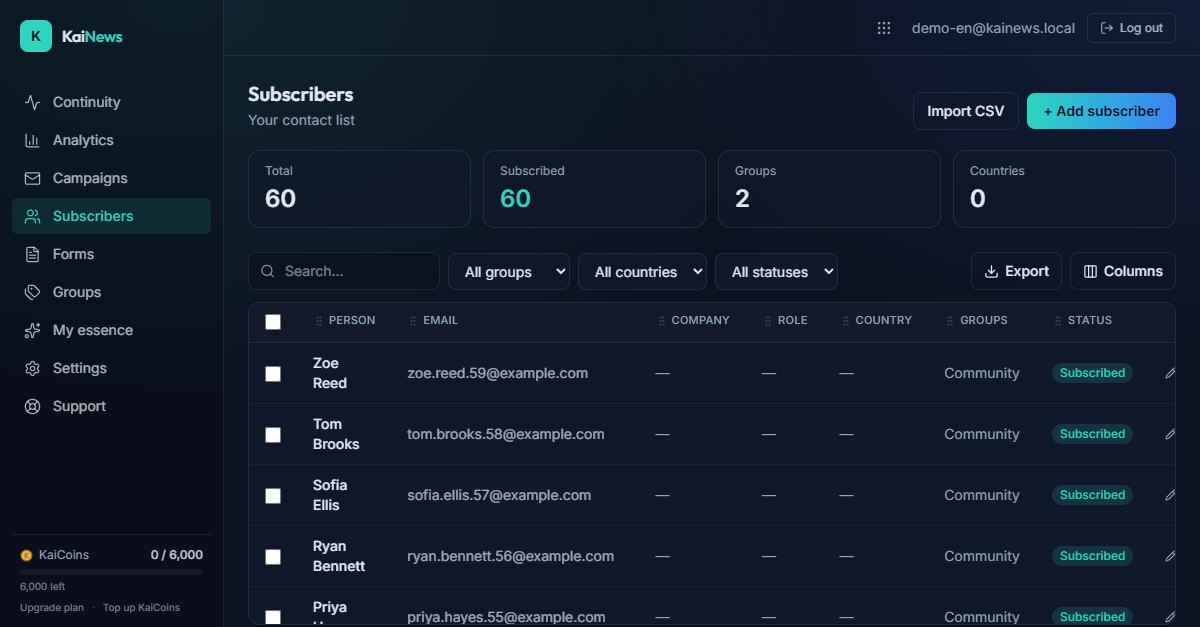
When they cut the limits, I decided to switch for good by doing something different, and that's where Kai News came from (I say this with the bias of the person who built it). It sends like any other tool, with confirmed permission, and it has a free plan of up to five hundred contacts, but sending wasn't what I cared about, because the big ones do that well. I cared about having someone tell me when I'd been quiet for too long, suggest what to talk about and help me write it in my own voice, and that's why, before it shows you any relationship numbers, it asks how often you want to write to your people.
I'm left with a question I can't answer well: how much of what we call an audience today is just people who saw us go by? On social media you can't tell, and on a list, at least, every person said yes. How many people do you have today who have already told you, one way or another, that they're interested in what you know, and where do you have them written down?
See you next time. Mauro Z.