Blog · Not disappearing · Leer en español · Ler em português
“I didn't get to write this week”: why a newsletter loses its rhythm and what keeps it going
Why a newsletter loses its rhythm, whether sending less often beats disappearing, and what keeps the relationship with your readers going when work gets busy.

“I didn't get to write this week” is something almost nobody says out loud, because when you think it, nothing happens: the list doesn't complain, no subscriber writes to ask where you are, and the email that didn't go out leaves no trace (except one: the next one weighs a little more). Nobody calls you on it. The following week you think it again, and the week after that, and one day you realize you've been silent for months with people who asked you, with their name and their email address, to write to them.
I know this firsthand, because my newsletter has almost always gone quiet for six, eight, ten months at a time (I wouldn't rule out that it once went past a year, and I'd rather not go check). The reason was silly, and it might sound familiar: I had tied it to my videos. When I put out a video, I sent a newsletter with the video; when there was no video, there was no newsletter, and my videos could take months on end.
Coming back was never hard for me, because I came back with something in hand. What I wasn't looking at was what happened in between: about three hundred people who had signed up, almost all of them after a talk, wanting to hear more, and who for months heard nothing from me (not a line, not even an “I'm still here”). In numbers, the difference is big, because one newsletter a month is twelve conversations a year, and a ten-month silence leaves just two.
The explanation we give ourselves is the usual one, lack of time, lack of discipline, work piling up, and it's true, because nobody has a free week to write. But I think the problem is something else. What people who write newsletters say in forums (and there are a lot of them) points the same way: you don't lose the rhythm out of laziness, you lose it because the newsletter depends on something you don't control, because that week you don't know what to say, and because nobody tells you the relationship is cooling down.
Why you lose your rhythm
The first reason is mine, a newsletter tied to something else: to videos, to a launch, to having news, or to inspiration showing up. If what you write depends on something that takes time, your list will wait as long as that takes, and in forums it shows up in many forms, from people who only write when they publish somewhere else to people who set themselves an issue so long it no longer fits in a normal week (and then none goes out).
The second is the blank page. There are weeks when there is time and there's nothing to say, or so it seems, because there's almost always something and you're too close to your own work to see it (what's obvious to you is often exactly what the person reading you didn't know). Running out of ideas weighs as much as running out of time, and it's sneakier, because it disguises itself as a lack of time and you end up telling yourself the wrong excuse.
The third is the quietest, because cooling down can't be seen. A social network shows you that nobody reacted to what you posted, while a quiet list shows you nothing: there's no red number telling you it's been five weeks, and nobody asking about this month's email. And what you don't see, you don't look after.
Better to send less often than to disappear
It's one of the questions that comes up most among people who write a newsletter, and my short answer is to send less often. An issue every two weeks that always arrives is worth more than a weekly one that drops off in November and comes back in March. Ciler Demiralp, who writes about newsletters at Newsletter Circle, says it bluntly when she writes that “there is nothing wrong with starting with a weekly or bi-weekly schedule,” and that “consistency will not be an issue if you have well-defined systems working on auto-pilot.” In the same post she quotes a line from Eric Lam that I like more than I should (“businesses should not be hard; they should be repetitive”), and it applies just as well to writing to a list.
The clearest case I found is Ben's Bites, an AI newsletter that used to arrive every weekday. In August 2025, Shanice Stewart-Jones, from their team, wrote on LinkedIn that a year earlier they had gone from five sends a week to two (less than half), and that the change “only had a positive impact” on the team, on their community and on revenue. Her line is the one I wish I'd read years ago: once they cut back, the newsletter started to feel “less like a firehose and more like a resource.” With one caveat, though, because it's the account of the people running it and not an experiment, and a team that sends every day isn't one person writing alone on Sundays.
So what's the minimum frequency? I don't think there's a number, because the one that works is the one you can keep up in your worst month, not your best. If in January, with the year just starting and your calendar still clear, you feel you could write every week, run the numbers against May (or whichever month everything piles up for you). For almost all of us who write alone, that ends up being every two weeks or once a month, and that's fine.
What actually keeps it going
- A cadence that survives the bad week. You decide it before the design, the name or the tool, and you write it down somewhere you'll see it again when the week gets complicated.
- Untie it from everything else. The newsletter doesn't have to wait for the video, the launch or the news, and it can share what you're thinking while that arrives (sometimes it's the most interesting thing you have).
- Two or three issues in reserve. For the week when there's nothing. The ones that don't depend on a date are perfect for exactly that.
- Lower the bar. A short issue that answers a question your clients ask you counts too, and not every one has to be an essay.
- Have someone tell you. If the silence can't be seen, you have to make it visible, with a reminder in your calendar, a colleague who asks you, or a tool that keeps count for you.
That fifth one is what I was missing for years, and it's why I built Kai News the way I did (take it with the bias of the person who built it). Before it shows you any numbers, it asks how often you want to write to your people, every week, every two weeks or every month, and from that a radar counts the days since your last send and changes color when you go past your cadence. If the silence reaches double that, it suggests three ways to reappear without guilt, and if you turn it on, when the relationship starts to cool down it writes to you with ideas for what to share that week, without you having to log in and check.
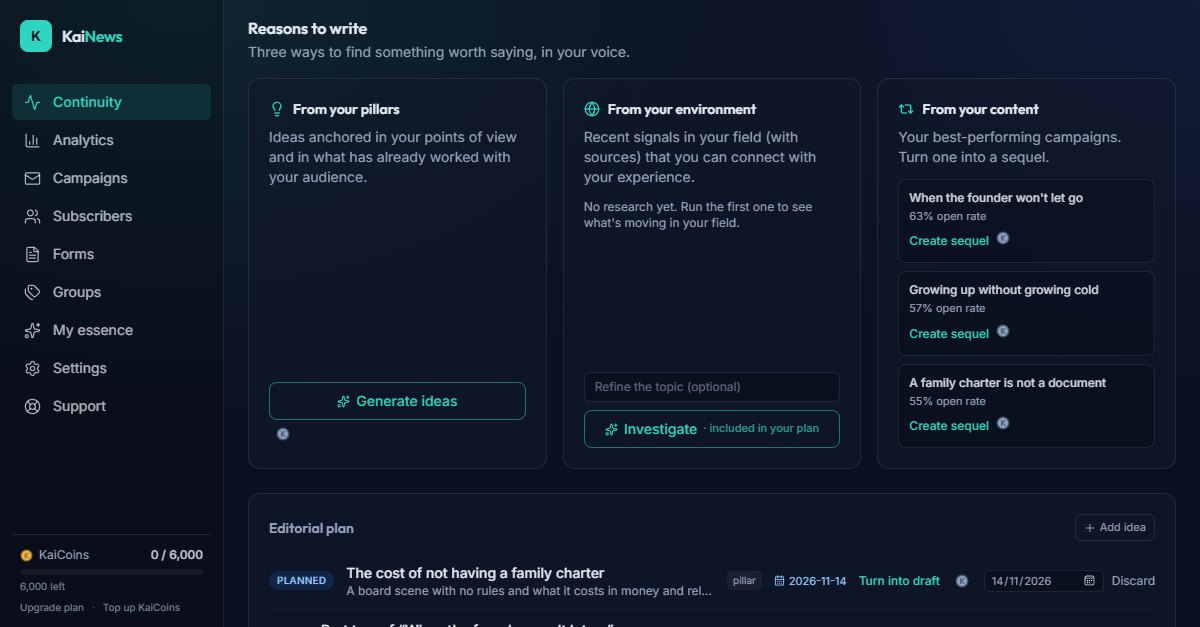
I'm not going to tell you my silences are over, because the radar doesn't write for me. But now that I use AI to help me write more regularly, it feels different, and I suspect that's because the problem was never the writing (coming back, as I said, was never hard): it was having a reason to write and something to tell me it had already been three weeks.
There's one question I haven't settled. Do you lose the rhythm because you lack time, or because nobody notices? My case says the second, because there were plenty of weeks with time and I didn't write because there was no video. What about you? What's the cadence you could really keep up in your worst month, and how long has it been since you wrote to your list?
See you next time. Mauro Z.