Blog · What to say · Leer en español · Ler em português
Christmas message for clients: six examples that don't sound canned
Six Christmas message examples for clients, by email or WhatsApp, that don't read like a greeting card, and how to use December to write to your list again.

A Christmas message for clients works when it says something only you could say to that person. You don't need a card or a pretty line for that, because it's enough to mention something you went through together this year, leave them something useful for January and ask for nothing in return. Below are six examples to adapt, by email or WhatsApp, and after that, what makes any of them sound canned, which is easier than it looks.
The canned part is what shows the most, and the first thing that gives away a message written for everyone and not for someone. “Merry Christmas and a prosperous New Year,” “hope you had a great year and the next one is even better,” “thank you for your business”: all the normal, standard phrases are far too obvious, and whoever gets them knows a hundred other people got them too. They're not false. They're generic, which in December is worse, because that month everyone gets the same ones and yours gets lost among the bank's, the gym's and the internet provider's.
I'll confess that, with my personal brand, I don't remember ever sending Christmas messages. I have written them, though, while promoting the brands of some of my ventures (a few of them with their own WhatsApp broadcast list), and there I know exactly what I don't want: the long, wall-of-text email with an academic air that nobody reads to the end. If I'm going to send something, I'd rather it be one line that gives something, or something useful, than a speech.
The only way I know to keep a message from sounding canned is to connect with what you know about that person. With a client it's easier than it seems, because there's the project, the meeting where something got unstuck, or the question they asked you in March; with a list it takes more work, but you can speak from what you've been through together, the topics you covered this year, or what you sent that someone replied to. What I'm after is that they at least feel it isn't an overly generic message, that something in it reaches them.
And there's one more thing, which is the reason this article is on this blog and not on a greeting-card one. December is the easiest month of the year to write again to someone you've lost touch with, because nobody wonders why you're writing. Among people with old clients or a list that's been silent for months, the same story keeps coming up in forums: any message feels like an excuse to sell, so you end up sending nothing. At Christmas that barrier almost disappears.
Six Christmas message examples for clients
- For a client you worked with this year: “Hi (name), this year we got (the project) over the line, and I still remember the meeting where (what got unstuck). Thanks for your trust. For January, here's (something concrete: the template, the summary, the contact I mentioned). Have a merry Christmas.” What you went through together, with a detail only you and your client know, and something useful for after the holidays.
- For a list or a newsletter: “This year I wrote to you about (three topics). The email that got the most replies was (which one), and the question I got asked most was (which one). To close out the year, here's my short answer to it: (the answer). Merry Christmas, and thanks for reading.” You can't talk to a list about their project, but you can talk about what you covered together this year.
- For a client you haven't talked to in a while: “Hi (name), it's been a long time since we talked, and (what reminded you of them) made me think of you. I wanted to wish you a good Christmas and tell you that (something useful for their work). If it would help to talk in January, I'm here.” To show up again without it looking like a sales pitch, the offer, if there is one, goes in the last line and with no pressure.
- On WhatsApp, in three lines: “Merry Christmas, (name). Thanks for this year. Here's (the link or the info) I mentioned, for when you're back in January.” Short, personal and with something inside, because an image on its own doesn't count as a message.
- For the clients of a practice, a studio or a firm: “Every December a lot of people ask me (the seasonal question). Here's the short answer, in case it helps you or someone in your family: (the answer). Merry Christmas.” When what you sell is what you know, the best gift is an answer.
- A single line: “Hope December leaves you time for what the rest of the year didn't. Merry Christmas.” When there's nothing to add, one line of your own beats three paragraphs of greeting card.
What makes it sound canned
Any of those six can be ruined with very little: the greeting-card line that sneaks in at the end (“wishing you peace, joy and prosperity”), the five-line corporate signature, the image of a Christmas tree with no text, or the same message with the name swapped out, sent to two hundred people. There's one that, on top of being canned, is careless: sending the greeting from your own email with every client in the “To” field, visible to everyone else (each of them just got the email addresses of all your clients). If you're going to write to many people, each one has to receive it as if it were only theirs.
And the timing? I'd send it the week before Christmas and not on the 24th, when nobody opens anything that isn't from family, though I'll admit it's more gut feeling than data and I've never measured it. What I do know is that a message that arrives on January 2 isn't a Christmas message anymore, and that December goes by faster than you think.
When your list has been silent for months
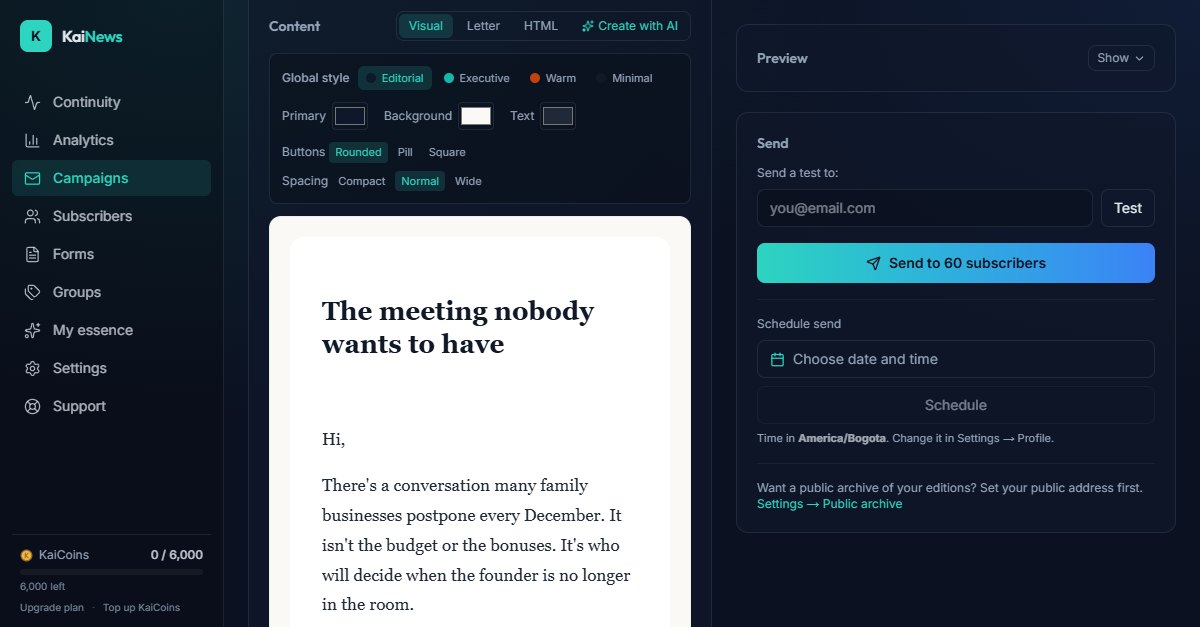
If your list hasn't heard from you in months, December is the best excuse to come back, and it's exactly the moment I wanted to solve when I built Kai News (take it with the bias of the person who built it). When the relationship has already gone cold, it suggests three ways to reappear without guilt, an honest reflection, a useful resource or a brief update, and it leaves you a draft written in the voice you taught it, so you can change it until it sounds like you. A Christmas message that works is almost always the second one: a useful resource with two lines of warmth around it.
There's a question I haven't settled. Does a Christmas message count as coming back, or is it a truce that's forgotten by January? I suspect it depends on what happens next, because if you disappear again in January, it was just one more card, and the conversation stays where it was. Who would you write to this December if you knew it wouldn't sound like a sales pitch?
See you next time. Mauro Z.