Blog · What to say · Leer en español · Ler em português
End-of-year thank you message to clients: seven examples that don't sound like a template
Seven end-of-year thank you messages for clients to copy and adapt, and how to thank someone for something specific without sounding like a template or a card.

What keeps an end-of-year message to clients from sounding like a template is that it thanks them for something specific that happened this year and says what changed because of it. Good wishes for the year ahead can go in, but at the end and in one line, because they're the part that reaches everyone the same. Below are seven examples to copy and adapt (for the client you worked with, for the person who referred you, for the one who's no longer your client and for your list), and before that, a way to say thank you that doesn't sound like a greeting card.
Almost everything that comes up when you search for this is lists of fifty or a hundred phrases, and I won't knock them, because if you need a line for the bottom of a card, there it is. The problem is that a line that works for a hundred clients is exactly the one that doesn't work for yours. On my list of phrases that sound canned, thank-yous come first, along with “Happy New Year,” “hope you had a great year” and “here's to an even better one” (you know them all, and so does whoever gets them).
The funny thing is that saying thank you is the only thing that really justifies writing in December. The problem isn't thanking people, it's thanking them in general. “Thank you for your business” says nothing to anyone because it names nothing, not what they trusted you with, not when, not what happened next, while “thanks for introducing me to your business partner in May, that conversation turned into the October project” is something you can only write to one person.
There's a study that fits here. In 2018, Amit Kumar and Nicholas Epley published several experiments in Psychological Science in which each participant wrote a thank-you letter to someone who had mattered in their life and, before sending it, predicted how the recipient would feel. They got all three things they measured wrong. They imagined less surprise and less happiness than there was, and more awkwardness than the other person actually felt (which is exactly the fear that keeps people from writing). The University of Chicago summed it up in a line that stuck with me: while the writers worried about choosing the right words, the recipients were simply happy with the warmth of the gesture.
I think that answers the question that comes up most when people talk about past clients in forums. In a Reddit thread for real estate agents, in December 2025, someone admitted they never know what to say besides “hey, how's it going,” and that it felt pointless. They're right. A specific thank-you solves that problem, because it has something to say and asks for nothing in return (which is what keeps a message from sounding like a sales pitch).
How to say thank you without it sounding canned
- What they did, with its date. “Thanks for recommending me to your team in March,” not “thanks for your support.”
- What changed because of it. The project that came out of it, what you learned, the idea that stuck with you. It's the part almost nobody writes.
- Nothing in return. Not the January offer, and not “let me know if there's ever anything I can do,” which reads the same. If you want to leave the door open, make it one line at the end, with no question.
- Short. Three or four lines. If it turns into a letter, even better, but then make it for just one person.
Seven end-of-year thank you messages for clients
- For a client you worked with this year: “(Name), before the year is out I wanted to thank you for (the specific thing: the meeting where you told me…, the decision to…). Because of that, (what changed: the project shipped on time, I learned to…). Hope you close out the year well.” What they did and what changed, in that order, and the wish in one line.
- For someone who referred you: “(Name), this year (the person or the company) came to me because you told them about my work. I'm not sure I thanked you at the time, so I'm doing it now: thank you. It led to (what came of it).” People who refer you almost never hear how it turned out, and telling them is the best way to thank them.
- For a client who isn't one anymore: “(Name), this year we wrapped up (the project, the contract), and I didn't want to end the year without thanking you for (the specific thing). I still use (what you learned working with them). Wishing you a good 2027.” No offer and no “if you ever need me”: if they need you, they know where to find you.
- For someone you haven't talked to in a year: “(Name), looking back on the year, I remembered (what you did together), and it's still one of the things I use most in my work. Thanks again. Hope the end of the year finds you well.” Looking back is a reason to write that needs no excuse, and it leaves no question that forces a reply.
- For your list or your newsletter: “This year one of the people who read this newsletter wrote back to me (what they said), and because of that (what changed: I wrote about…, I stopped…). I'm grateful to them, and to you, for reading this far. See you in January.” You can't name everyone on a list, but you can name something that really happened in this year's conversation.
- By text or WhatsApp, in two lines: “(Name), thanks for (the specific thing) this year. It helped me (what changed). Happy holidays.” If it fits in two lines, it doesn't need an image.
- If you didn't get to it in December, in the first week of January: “(Name), I'm starting the year by thanking the people who made the last one good, and you're on that list because of (the specific thing). Happy New Year.” “Happy New Year” works in January, as long as it comes after something only you could say to them.
This article comes out at the end of November on purpose. In the United States, Thanksgiving week is the natural time to thank someone; if you miss it, I'd send it the first week of December, before the month fills up with greetings, because a thank-you that arrives on its own reads differently from one that arrives with twenty others (though that's a hunch, I haven't measured it). And if what you're after is the greeting for Christmas, which is something else, I already wrote about the Christmas message for clients.
When you're writing to a list
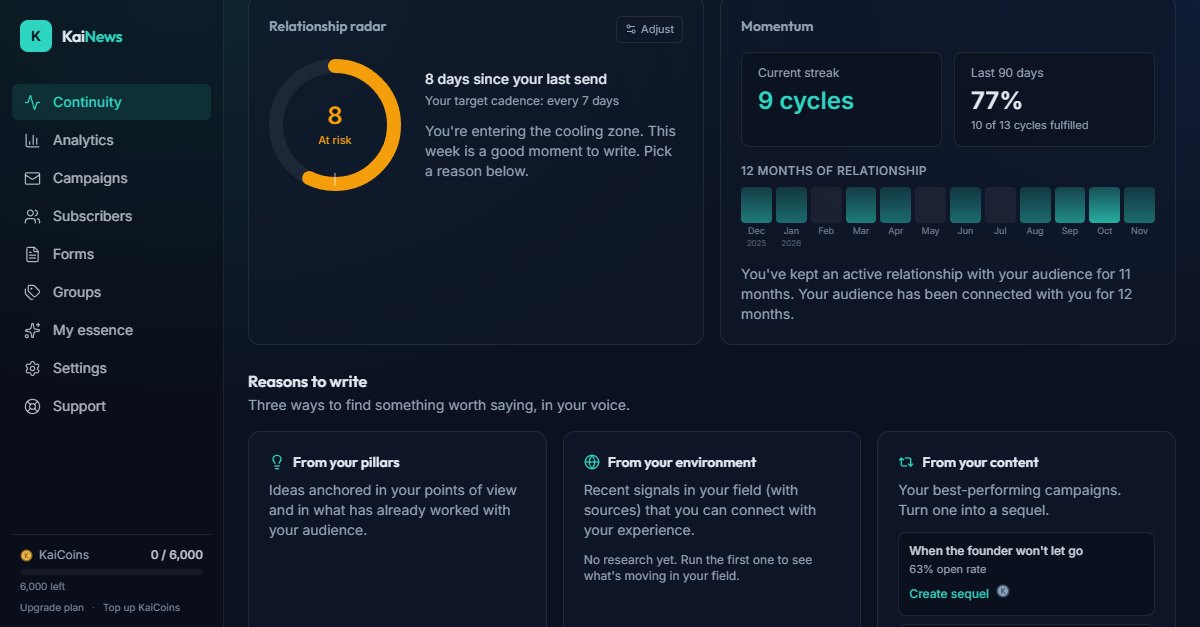
With a client, what you went through together lives in your memory. With a list, it's spread across the year's emails, the topics you covered and what some people wrote back, and to find it, it helps to look at what got read the most (which is almost never what you'd expect). It's part of what I wanted to solve when I built Kai News, and take it with the bias of the person who built it: a twelve-month calendar shows you which months you wrote to your people and which you didn't, and the three issues that got opened the most are one click away from becoming an email that picks up that idea, as a draft and in your voice, so you can change it until it sounds like you.
There's a question I haven't settled. Is thanking a whole list really thanking, or is it another template with better manners? I suspect it only works if you name something that really happened, even a single reply from a single person, and that the rest is just one more card. What's the most specific thing you'd thank a client for this year, and have you told them yet?
See you next time. Mauro Z.